Monday, April 28, 2008

The First Annual Women's Week - March 5 - 9, 2008

Members of the Woman's Club:
The First Annual Women’s Week Celebration was a great success. To celebrate the official International Women’s Day, the Club de Madres (Mother's Club) and I carried out a week of events, for women and by women. The recently re-formed Mother’s Club came together out of concern that there were not enough opportunities available to women of the community. The club began the year by bringing three different vocational courses to the community, offered to women free of charge. These courses included sewing, cooking, and massage. At the same time, the Mother’s Club began planning for its first annual Women’s Week.

Wednesday March 5th - Health and Justice
“La Semana de la Mujer” (Women’s Week) began with charlas (educational presentations) given about women’s health and women’s rights. The health charla was given by a local doctor of the community, Dr. Carmen Bonilla (pictured at left), and treated subjects such as basic health, how to do your own breast self-exam, the importance of regular pap smears, and more. Representatives from the official “Oficina de la Mujer” (Women’s Office) of Nagua spoke about women’s rights, particularly in relation to violence against women. There were about 45 people in attendance, and the women who attended the charla were very interested in the information and happy with the outcome.

Thursday March 6th - Recognition Night
Thursday saw our most talked-about night of the week, “La Noche de Reconocimiento” (Recognition Night). During this evening, we awarded twelve women of the community with mounted certificates for the variety of services they have contributed to the community in representation of strong and successful women. Included in the list of award recipients were: a nurse, a doctor, a political representative, teachers, cooks, a nun, and other women who represent a spirit of strength and courage. The Club de Madres insited on giving me an award as well for my work in the community. We also recognized a “Madre Ejemplar” (example mother), to award one woman for her work within the home and family, and to represent the importance of those whose work remains in the household.

Recognition night took the town by surprise. Invitees arrived not knowing what to expect, and witnessed a group of people congratulating women for their everyday work and for being themselves. The school director, a man named Radhames Alvarado, approached the microphone with a look of awe and spoke to the crowd, commenting, “We have never seen anything like this before. This is the first time we have had a night specifically dedicated to the accomplishments of women.” Other key community leaders were present and all had very positive things to say about the event and the importance of this gesture. A few women, inspired by the evening, took the microphone and, fists pumping in the air, called out their own words of inspiration or reflected on their own personal accomplishments. The night was a huge success, and people in town continued to talk about it for weeks to come.
This is Elizabeth, a nun from Mexico who lives and works in the community:
Here I am as I accept my award while struggling not to fall in my borrowed fancy shoes:
Here I am making a joke during my acceptance speech:
Friday March 7th - Adolescent Health
Friday took us to the local high school, where Peace Corps Volunteer and friend Idonah and I carried out charlas for two groups of high school girls. We touched on many important themes such as: understanding the human body, menstruation, pregnancy, birth control methods, and HIV/AIDS. This education is vital to girls of this age in the Dominican Republic, though in many cases youth do not have the opportunity to learn about these issues. Too often young girls end up having unprotected sex, many times ending in teenage pregnancy and as a result, marrying young, dropping out of school, etc.

The girls sat wide-eyed as we taught them about their own bodies and what was happening to them. Things like menstruation, pregnancy, and sex are so taboo in this country that they rarely get a decent explanation of them and are left to fend for themselves when faced with these critical events. We made learning fun for them by playing “Pin the body part on the woman”, and teaching them how to put a condom on a plantain. The “girls only” environment was beneficial as they did not have the pressure nor embarrassment of wondering what the boys were thinking, and felt comfortable asking lots of questions. (Ideology borrowed from Camp GLOW) I selected some of the girls from these groups to continue their education and training in sexual health as members of my new youth group, “Escojo Mi Vida” (I choose my life) and to be multipliers of the information so that they can give their own charlas and continue spreading this important information to youth of the community.

Saturday March 8th - International Women’s Day Celebration
After a week of lectures and informational sessions, we decided that we wanted the official “Día Internacional de la Mujer” (International Women’s Day) to be a time to celebrate and have fun. We called all women to the basketball court for an afternoon of singing, dancing, and prizes. The women were a little slow to arrive, and after seeing the mostly older crowd in attendance, we decided to skip the dance contest and stick with the entertainment portion. Club member Yinelis is well-known throughout Matancitas for her beautiful voice and sang a variety of both cover and original songs, accompanied by Daniel on the keys. Daniel and his friend Eduard also contributed to the afternoon special with songs and serenades dedicated to the women in the crowd.

We had lots of prizes, having had received donations of gifts and money to buy gifts from local community members and businesses. The number of attendees was small enough that each participant walked away with a prize. There were about 60 people at the event that afternoon. Accompanying everything were lots of refreshments and beautiful afternoon weather.

Sunday March 9th - Medical Mission
For the final day of the week, the Mother’s Club helped organize and carry out a Medical Mission. Three female doctors of the community provided their services at discounted prices to community members, with specialties in cardiology, gynecology, and pediatrics. Two of the doctors come directly from our town while the other lives in nearby Nagua. It was helpful for community members to have this mission as they not only saved money off the normal consultation and exam costs, but they were able to stay with their regular doctors. The turnout was not as high as we had hoped it would be, but many women did take advantage of their services, especially pap smears and cardiograms.

Overall the week was a huge success, and something that the Club de Madres hopes to continue for years to come.

Thursday, April 17, 2008

Crystal's "Vacation"

So I have to say visiting the Dominican Republic was more of an ‘experience’ than a vacation, as Joan’s dad put it. I had no idea just how simple Joan was living. I knew she didn’t have much but I didn’t foresee having no shower or refrigerator. She never complains about any of these things when we chat on the phone, which is pretty often. I never had the desire to stay in resort land but I guess I wasn’t as tough as I thought. I have to say I missed the luxuries of home. Thinking back on it I think if I did some research on the country I would have been more mentally prepared.

Another reason it was tough was because of the language barrier. I had to depend on Joan for all of my communication. She is pretty fluent now, and doesn’t mind, but it definitely feels strange to depend on someone else to speak. Even though I know a little Spanish I feel intimidated to speak it even though everyone is graciously friendly. It was astonishing just how friendly people were. Joan knows everyone and they all love her. We had three meals at neighbors’ houses, and each time they always served the guest first. They have so little yet they want to make sure you have the most. Back home it is not unusual to be kind to guests, but they truly go out of their way to satisfy you. You can tell how much Joan has adapted and truly become part of the community.

It was difficult too because I am in school all year so I do not get to take many vacations. When I do go on vacation I am ready to splurge, since I rarely do. Joan was not on vacation and was working all week, and makes pretty much enough money to survive, so we weren’t exactly on the same page as far as spending and doing activities. And she never complains about this! I am glad now though because I truly don’t have the money to splurge either. I always knew she was the right type of person for the Peace Corps; she truly always looks out for everyone. That’s why she’s My Girl Joan. One of my favorite things was the food because it was mostly fried and bland (which I love). I also love the music and dancing. I cannot believe how strong the sun was there! I knew it was much closer to the equator but I could not imagine that you really need to shade yourself with an umbrella during the day. I was skeptical at first but when I didn’t use the umbrella I got a headache within twenty minutes. This is not an exaggeration.

Overall the trip was more valuable than I realized during the week. I became more grateful for all that I have. Most people in the U.S. will have more money than the people in the Dominican Republic will think about having or needing. It reminded me of how many freedoms we do have in this country. It is extremely difficult for anyone in the Dominican Republic to get a visa to travel to any other country, even for a week stay visiting a relative. Even if families were granted a visa it would be very difficult to afford the expense, especially since a meal for a family in an inexpensive restaurant would be cumbersome considering the exchange rate. We can pretty much travel to any country we want. I would never even think about the fact that not everyone has this freedom. I am also more mindful of how hard it is for immigrants to adapt to a new culture. It was difficult for me, and I was only staying there for one week. One of the most amazing things about traveling is how much you can learn and how your perspective changes over time. When you travel it changes you and keeps on changing you even after you have gone back home. You might not even realize it until years later. It is pretty amazing.

Joan's Note: We also went to a beautiful beach:
Joan climbing an almond tree:

Crystal drinking her Piña Colada directly from the Piña:

Joan's Dominican "Grandparents" Sonia and Bolivar:

Tuesday, March 25, 2008

Nurse Joan


One of the most impactful experiences of my time in the Peace Corps has been my participation in a Medical Mission in the beginning of February. A group of doctors headed by Dr. Thomas Geraghty, mostly from the Kansas area, comes every year for two weeks in February to perform free reconstructive and plastic surgeries for underprivileged Dominicans. Certain medical missions that come to this country call upon Peace Corps Volunteers to help with translation and organization of the events. Peace Corps Volunteers make good translators for events such as these because we not only know the language with all of its Dominican intricacies, but we are aware of cultural workings too. Peace Corps Volunteers have helped with Geraghty’s missions for many years, and Dr. Geraghty has been doing this mission for almost 25 years! Check out his web site when you get a chance: www.macla.org/

I had known about this particular mission for over a year and had been planning to be there to participate for an entire week, but with work picking up in my site I unfortunately wasn’t able to leave for such a long time. I did, however, bring two members of my community to see if they would qualify for the free surgery.

After mentioning the mission to a few friends and that I was looking for candidates, they referred me to a youth of mine who had a twisted thumb. I had never noticied it before, but his left thumb was bent sideways from the top knuckle. He didn't have much movement in the thumb, and it was harmful to his self-esteem to have other kids notice his deformity. I invited him to make the trip with me to the capital, and told him that the doctors could set him straight (literally):

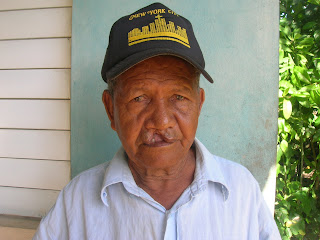
The other candidate I brought was Ñuco. Ñuco is a man of about 60-years-old (though no one is actually sure of his age nor birthday). He’s lived his entire life with a severe cleft lip. Throughout his lifetime, not only had no one ever tried to fix his lip, but he had never even been to a doctor. It was a matter of poverty, but also, with this deformity, he was considered an outcast and no one really gave him a second thought. It pained me to see this man reduced to his state, while thinking that if only someone had performed this relatively simple surgery when he was a child, he could have married, had a family, and had a normal life. Instead, he’s the guy with the cleft lip, and people are afraid of him. Even though I knew it was probably too late in his life to be doing this, I brought him to the capital anyway to see if he would qualify for the surgery and get that chance he always deserved. Better late than never, I thought. Here he is:

The night before we were to leave, I went to check on him to see if he was ready. He had had his bag packed for a day and was very excited about the trip. His niece, my good friend Niña, confessed that this was his first trip to the capital. Can you believe it?!? Sixty years and he had never been to Santo Domingo, and as I learned, hardly even left his community. We took and early bus at 4:00am and arrived in the capital by 8:00. As we pulled up in front of the hospital we saw all of the surgery hopefuls who had come from all parts of the country waiting outside the building in a line four-people-deep that stretched for about two city blocks in two directions. Some of the reasons people came in for were obvious, for example, there were many people in line with cleft lips. I think it was good for Ñuco as he realized that there were many other people just like him, that he wasn't alone in the world.

As Peace Corps, we had an advantage over the others and brought our patients to the front of the line. I helped control the order of patients receiving consultations with the other volunteers until my patients' numbers were called. We met personally with Dr. Geraghty and both of my boys were approved and passed along to the next level - the checkup. Every surgury hopeful had their vital signs taken to make sure they were healthy enough to go under anesthesia (which can be very dangerous in certain situations). My youth was approved and given his surgery date for two days later. Unfortunately, in the end Ñuco did not qualify for the surgery because the doctors were worried about his heart and didn’t want to risk putting him under the anesthesia. It could be that he has heart problems, but also it could be that the man was simply terrified at being examined by a doctor for the first time! In the end it ended up being a great experience for him. He got to see the big city for the first time, and had an experience he will never forget.

While we were there in the waiting room waiting for a checkup, I jumped right in and helped translate for a Dr. Larry. It was so amazing to be right in there on the action. I helped Dr. Larry as he examined each patient. I saw all kinds of burns, scars, and deformities that I never in my lifetime thought I’d be seeing in person. My mom is a nurse, and it has always been difficult even just looking at pictures in her medical books. Though not once did I feel uncomfortable speaking with and helping these patients, many with pretty extreme cases.

I went back two days later with my youth and we waited for his surgery, which was scheduled for 9:00 that morning. Things were a bit delayed so in the meantime I changed into scrubs and jumped right in again, helping with translation, comforting patients, getting them ready for surgery, and even go into the operating room! I helped Dr. Larry again this day as he gave keloid injections to people with big scars. He commended me on my ability to watch the injections, saying, “I like having you around. You don’t need to look away like the others do!” Here’s Iris (another Volunteer) helping Dr. Larry with the injections:
Here I am with Becky, an IT Volunteer:
I never in my wildest dreams thought I’d be able to handle the work of a nurse, but not only did nothing bother me, I learned that I actually enjoyed the work! Not only that, but I watched the entire surgery of the youth that I brought to the mission! Have I found a new calling? I’m not sure, but I will say I’d like to participate more in missions such as these.

Now I’d like to tell you about Edelberto. Edelberto is a 28-years-old patient I met at this mission. About a year-and-a-half ago, he was working at a paint store when the store caught on fire. He ran into the burning building to save his boss, carrying the man in his arms through the flames. In the process, Edelberto burned most of his body from the chin down. The skin on his arms melted to itself where the arms bend at the elbow. He has since had numerous surgeries to help fix some of his injuries, but he suffers daily. He had skin transplanted from his leg to his arms and now has fairly normal function of his arms. His skin was burned badly, however, and he has to be very careful with simple day-to-day habits: he has to bathe with warm water (not common down here); he can't be bitten by mosquitos, and needs to wear a special long-sleeved shirt at all times to protect his skin. He has had grafting done to try and promote better skin growth, and because of it his skin looks scaly. He is a good soul who risked his life to save another, but in the process lost everything. The boss he tried to save died six days later, and the family never did anything to thank Edelberto nor check on his condition. His girlfriend and friends slowly disappeared. He depends on his mother for help with many things.

I got to know Edelberto because he was also waiting on the day of my youth's surgery. Both were waiting for finger surgeries, and waited an entire day without food or water to be ready for the anesthesia, until 5:00 when we found out that they wouldn't be able to have the operations that day and would be rescheduled for the following day. Because we all came from far away, I became responsible for finding Edelberto and his mom food and lodging for the night.

In speaking with him I got to know him and realized how smart and funny he was. It was his mom who told me later the details of his story. I learned a lot from getting to know this man. It is just so heartbreaking to meet someone so cool, who had been so happy and successful before this accident, but see how much they suffer and know they might never be "normal" again. To see how quickly your entire life can be turned upside-down. For me, Edelberto was one of those people that you meet every so often who teaches you something about yourself and about life. There were many others at this mission as well - people who suffered a random accident and lost so much. It just makes you realize how lucky were are - that we do not live daily in physical pain; that we live in a place where they fix simple deformities, such as cleft lips, at birth; that we are so incredibly lucky just to be "normal".

To end this blog entry, my youth's finger is fine now. It is still not perfect, and he still does not have a lot of movement in his thumb, but with some therapy it should improve. I want to commend all of the doctors from this mission who gave their time and money to come here and do such incredible work - out of there own pockets, and their own generocity. Thank you.

Thursday, March 20, 2008

Stressed out in the Peace Corps

I’ve got a big period of time to make up for on this blog, so I'm going to divide the past three months into three different entries: general work, the Medical Mission, and Women’s Week. Here we go…

GENERAL WORK

January: the holiday season had ended, and a new year had begun; it was time to start some new projects. I had been dodging the bullet of the imminent English class that they’d been bugging me to give for over a year, until finally they cornered me and I had no choice but to do it. Why wouldn’t I want to give an English class if so many people wanted it? I have many good reasons, here are a few:

1. It is nothing they haven’t learned before. They have basic English classes in primary and high school classes.
2. Its nothing they don’t have access to already. You can sign up for many independent English classes in nearby Nagua.
3. Its not sustainable. Once I stop giving the class, there is no one to continue it.

What it comes down to is that they just want to hear it directly from the American. They want to hear how I say things because their Dominican teacher might not pronounce things quite correctly. So you can imagine why I don’t feel this class would take priority over other things that are more important and that I would rather be doing, like sex ed for youth, who in the meantime are getting pregnant. Peace Corps also discourages English classes for these same reasons, saying it should really only be used as filler work if you have nothing else to do or are just getting started and looking to meet people, establish credibility, etc.

WELL, after all that bitching, the English class ended up being pretty fun, and the (dedicated) students I had in my class really seemed to enjoy it. I taught to youth and adults, generally 18 and up. I met some new people and had fun making different handouts and activities for them to practice with. There are two German volunteers in my site now as well, and one of them, Manuel, took on the younger class while I taught to the older students. The Peace Corps has a pre-made 16-lesson basic English course guide and we both just used that. I finished last week, and when Manuel finishes his class we will have a combined graduation. They’re bugging me to do a second level, but there are other priorities that I have that I want to do so I won’t continue. Manuel is planning to do the second level.

I don’t have any pictures from class, but I’ll make sure to take some at the graduation.

Speaking of the German volunteers, Manuel and Laurin arrived last September to work here for a year doing similar work in education and with sports. It’s a program along the same idea as Peace Corps though for less time, and the volunteers are just out of high school. They approached me before they moved in to see if this would be a good place to live and work. At first I was a little unsure about sharing “my site” with other foreign volunteers, worrying that they would be competition or that they would show me up, but before I knew it they had rented a place on the other side of town and had already begun their work, so I didn’t have much of a choice. As it turns out, we get along great, and have started collaborating on different projects (such as the English class). There truly is strength in numbers! It actually works out really well because this town is big enough so I focus my work in one neighborhood and they in another, and we don’t have to interfere with each other if we don’t want to (though we do and its fun).

Between vacations, the Peace Corps magazine, tropical storms, holidays, trainings, etc., I was out of my site for most of October through December, so I didn’t really get to know these guys until this past January. Once we had a few opportunities to talk we discovered that we get along really well, and decided to do a project together. At the end of January is the official International Youth Day. Together we planned an internationally-themed event for this day. We invited 70 youth and taught them about the different cultures they have represented here in their own community. I taught them things about the United States, the others about Germany, a foreign exchange student came from Nagua and taught them about Switzerland, and we even planned a Haitian unit as well. Unfortunately, the Haitians I invited didn’t come, they misunderstood and thought I was going to bring them to the meeting, while we were waiting for them there. This was a shame, because the Haitians are highly discriminated against here so we were hoping that by teaching Dominicans a bit about Haiti and where these people come from, they might have a better understanding of them and treat them differently. We still mentioned the bit about Haiti, but without the people there it wasn’t quite the same.

However, the rest of the afternoon went well. Another friend of mine, fellow Peace Corps Volunteer Lily who arrived this past fall, also came with some of her youth from a community about 45 minutes away. We all made typical food from each of our countries for the kids to try: I made apple crisp, Lily made PB’nJ sandwiches, and the Germans made German pancakes with Nutella. After teaching them about our countries we had them each make presentations representing each place and then played Jeopardy to see what they learned. It got a little rowdy in the end, but overall was a great success.


January also brought me a visit from Crystal! Since projects had started I did have to work, but we managed to go to a beautiful beach in the Samaná peninsula and spent a night with a few other Peace Corps Volunteers in Samaná city. She got to experience the day-to-day life in my site and meet many of my friends. I’ll let her tell you about it in her upcoming blog.

In early February I participated in a Medical Mission. More on that in the next blog entry…

Mid-February saw the next issue of the Gringo Grita magazine. Some of our staff members are finishing their service, so unfortunately this was their last issue. As usual it was a long and stressful week, but not without its share of laughs. I think we’ve got a pretty good issue this time. Here’s the cover, it’s a poor Peace Corps volunteer returning home after his service, take from it what you will:


Carnival closed out the month, celebrating the Dominican Independence Day on February 27th. This was my second Carnival experience here (you may remember last year’s entry, “The Ozzy Ozborne Incident”); luckily no animals were brutally murdered this time. This year they had more dancing and costumes and incredible masks made by the youth.
I dressed up this year. My costume was one that only I could pull off (literally), because I went as a Dominican. A Dominican schoolgirl to be exact, wearing the official public school uniform and doing my hair in their braids. People got a kick out of it. Here I am with Ada (not sure what to call it but a funny costume), and Jenny as a “china man”. I know this is an incredibly politically incorrect costume to wear, but before you judge her let me confess that this is MY costume. I actually bought it and wore it on Halloween (one of only two to choose from in the store), but political correctness doesn’t matter here. Hey, I call friends “Negro!”
Reylandi with some Carnival people:
Throughout January and February I had been working with the Mothers Club planning for Women’s Week at the beginning of March. That blog entry is also to come.

After two intensive months of lots of hard work, I just had to take a break. On March 17th I went again to Cabarete to visit Bianca and celebrate…you guessed it, St. Patrick’s Day! In probably the only place in the country where they celebrate it, it was a bigger event this year than last year, with a stage and lots of seating on the beach behind Jose O’Shays restaurant. It felt good to wear green and eat a hamburger with fries and hear Irish and American music, though St. Patty’s Day on the Caribbean beach never feels quite the same. Nonetheless, we had a great time. Here I am with Bianca (left) and Erica (right, a new business volunteer). We do not know the guys, they just jumped in the picture:


I've also started a mini girls group with kids from my neighborhood around 10-years-old or so. I have a kids book with five chapters that we are reading together, and other than that they play and dance. This day they decided to throw a girl named Emily a party to make her feel better because she was upset the day before. Too cute:

More to come soon…

Saturday, March 01, 2008

Who needs a resort? - Dad's Blog

Date of visit, 12/14 – 12-26-07

I first want to say that I am very proud of what Joan has done in the Peace Corps. To drop down into a village and have to assimilate, learn the language and customs, work with the local committee and identify needs in the community, come up with a plan and make it work is not as easy as it looks.

So while we looked forward to visiting Joan in her village, we first couldn’t wait to see her at the airport and the anticipation of meeting her as we got through customs was deflated when we couldn’t find her. We were also not sure our phones would work, I tried to test the roaming update feature and that did not appear to be working, so just tried to call her number and finally figured it out. It turns out her alarm didn’t go off and she was still asleep in her hotel room in Santiago. Once she finally arrived we got our hugs in and made the somewhat precarious trip over a mountain road to the resort. Due to the recent hurricanes and rainstorms that had flooded the area only a week before, the road was still riddled with washed out areas, huge potholes on a curvy road that didn’t have any guardrails. The fact that is was dark and we were tired worked to our advantage.

Once we got to the Windsurf Resort in the town of Caberete, we found out the hotel had it’s share of problems with the weather and that the route to our room was flooded with water requiring us to remove our shoes and walk through it to get to our stairway. Not a good first impression, but luckily our rooms were on the 2nd floor so all was dry up there. The ground dried out by the next day and we were able to go our way without wading through water.

The resort itself is a bit tired and in the process of renovation and picky travelers would probably have been a bit perturbed by the accommodations. But we kind of liked the fact that is not pretentious and we felt that we could relax and be ourselves. For Joan and her Peace Corps colleague, Bianca, who visited us from her village a few miles away where she was bathing in the river due to recent flooding, the opportunity to take a hot shower mad it feel like a 5 star resort. The advantage of staying at a place like the Windsurf Resort is that it is not a protected, gated resort so that you have an opportunity to experience the town with all it’s good and bad points. The disadvantage is that you are not protected from constantly being hit on by the locals to purchase jewelry, pasties, get a massage, braid your hair, and even shine your shoes. In one way you have to admire the pluck of the locals, especially the shoeshine boys trying to sell shoe shining when 95% of the people are wearing sandals! But after awhile you just want them to leave you alone.

We met the owner of the resort, a Londoner of German descent by the name of Rodney Geminder, I called him Sir Rodney, and we had a number of interesting conversations about his plans for the resort and views of life. Rodney has been living in the DR for about 30 years and spends most of his time there. He has a true affection for the people, he refers to them as physically very beautiful and appreciates their overall friendliness. While he appreciates the slower pace of life, he does get a bit frustrated with it from time to time and then feels the need to head back to London for a dose of reality and to remind him of why he enjoys the DR. He also takes it upon himself to feed the stray cats that visit the resort, referring to himself as the “catman” and the following picture shows him with one of his cat friends. He also commented on how some of the guests at his resort in the past have objected about the resort. He thought that we were good travelers in that we more or less took things in stride and were willing to enjoy the experience that presented itself rather than complaining about trivial inconveniences. Some travelers that are perhaps less experienced or lead more sheltered lives tend to be better off at an all inclusive, sheltered resort experience. Well enough pontificating about what great travelers we are, I am sure Rodney sees the new resorts being developed right down the street and his “resort” is undergoing a big expansion and renovation and will be a different experience in the coming years.

One day we embarked on a guided tour of 4 beaches and a location that enabled us to see and taste coconuts, passion fruit, coffee beans and other local foods in a neat setting. Our leader for the trip was local character named Rafael Mercedes. A very energetic man with an infections laugh and a willingness to help you with whatever you might need. We ended up renting his Honda CRV for 3 days for $50 Cash per day, all-inclusive, it was definitely one of the best deals I have ever had.


We used the vehicle to the Playa Grande golf course ( a very nice experience, right on the ocean and a great caddy ) and also to take a trip to Samana Peninsula town of Las Terrenes to visit Joan’s friend Ricky. We met the entire family, had a delicious meal cooked for us and then loaded up the family, 10 of us in the CRV, to the nearest beach, Playa Bonita, over flooded pot hole ridden roads, it was fun actually.

The beach itself was truly beautiful, we went down some trails to a more secluded area, there was no one there trying to sell us anything, the water and beach again was warm and beautiful and there was even Noni fruit available for the picking in the bushes near the ocean. Just a wonderful and neat experience, wished we had more time to spend there. We made a quick stop at Joan’s village on the way back to the resort, but it made for a long day on the road and we turned in the car the next day.

Mary mentioned our stop at the Blue Lagoon in her blog contribution, we also stopped at 2 other beaches, the water was warm, clean and wonderful and we got a chance to meet and make friends with some of the other guests, so it was time well spent.

Overall, we enjoyed our time in Caberete, but were looking forward to our visit to Joan’s village. So we hired one of Rafael’s drivers to take us to Joan’s village of Matancitas and almost made it to the village before being stopped by the local military who apparently were looking for weapons. I am glad I wasn’t driving that day! Our driver seemed to know what to do and we were on our way.

The experience in Joan’s village was a lot of fun. Waking up to the sounds of various roosters every morning was certainly new to me. Add to that the neighbor who was working on his house and sounded like he was peeling off his metal roof and the people across the street who insisted on playing their Spanish music so the entire neighborhood could hear every morning between 7 – 8AM meant that we didn’t sleep too late and were ready to start the day.

We enjoyed meeting all the people in Joan’s community that we had heard about. It was a bit frustrating from a conversation standpoint in that our Spanish was better then most of their English. Poor Joan’s head was spinning by the time we left and there were times when she was talking to me in Spanish to the Dominicans in english. If I head back for another visit I will definitely want to work on my Spanish.

Because the weather is always so warm and the houses so small and in most cases not air-conditioned, most people are out every night so meeting people is extremely easy and in most cases unavoidable. It creates a sense of community that is certainly lacking in our culture due to our internal media centers and our busy lives. Drinking beer for example usually involves a group or people sitting around with small plastic cups sharing a large bottle of Presidente and chatting in front of someone’s house. In any event there are always people out and about, music playing and many outdoor and indoor opportunities to do Merengue and Bachata dancing. I personally want to thank Tina for showing me some great meringue moves. Joan showed me the basics to get me going, but Tina definitely took it a step further.

While what I am saying sounds very idealistic and ignores many of the issues that exist in the DR that Joan is trying to work on, it is refreshing to see that people can adjust to their circumstances and learn to live with less. In one way it makes you appreciate what you have but it also reminds us that less can be more, boy that was deep!

We also met Harry, an American expatriate, who has lived there for about 30 years now and is married to a local Dominican woman, Deysi (Daisy) that he met when he went to the DR to teach English. Harry is 79 years old he has a 24 year old son named Albert - gotta love that. Harry is the type of person that can make and fix anything, so he has an elaborate backup generator system that seamlessly kicks in whenever the power goes out. Thanks to Albert and Harry’s tools, we were able to get a bucket and some wire that we could rig up to a pole that Joan had to get water out of her well. Albert also came by after we left to get Joan’s water pump fixed so she now has running water, even thought we didn’t have it during our stay. We didn’t get a chance to see Harry again, but would like to look him up again if we ever go back.

We had meals cooked for us by 2 different families in our 4 nights at Matancitas. Niña actually came to Joan’s house and prepared dinner one day, a delicious chicken dish with rice. We had Christmas dinner with the Alvarado-Florimon family, I think there were 16 of us enjoying a smorgasbord of food, the highlight for me was the coconut flavored rice. The coconut was first shaved from fresh picked local coconuts, then the coconut milk was hand squeezed by Ada and mixed into the rice - deelish!

Despite the fact that rumor had it the electricity was not going to be shut off by the local powers that be, no sooner had we raised our glasses with a fresh pour of Presidente in anticipation of enjoying our feast when the lights went dark and we were scrambling for light and power. After the initial moaning, we quickly got various lanterns, candles and battery operated lighting (brought from the U.S.) in place and had a wonderful time. Followed by dancing in the front room with music powered by a hand cranked portable radio, good times!

There were many other positive experiences and people that we met but this blog entry is probably too long already so I will stop here.

Because we were only there for 4 days in the village, we didn’t get that may opportunities for revisits, so despite my initial reservations about staying in Joan’s village, next time we visit we will just go straight there and skip the “resort”.